
Thread lift
A thread lift places physical sutures beneath the skin to support and reposition selected tissues. The result depends on anatomy, thread design and technique. It is a minimally invasive implanted-device procedure with its own recovery and risks.
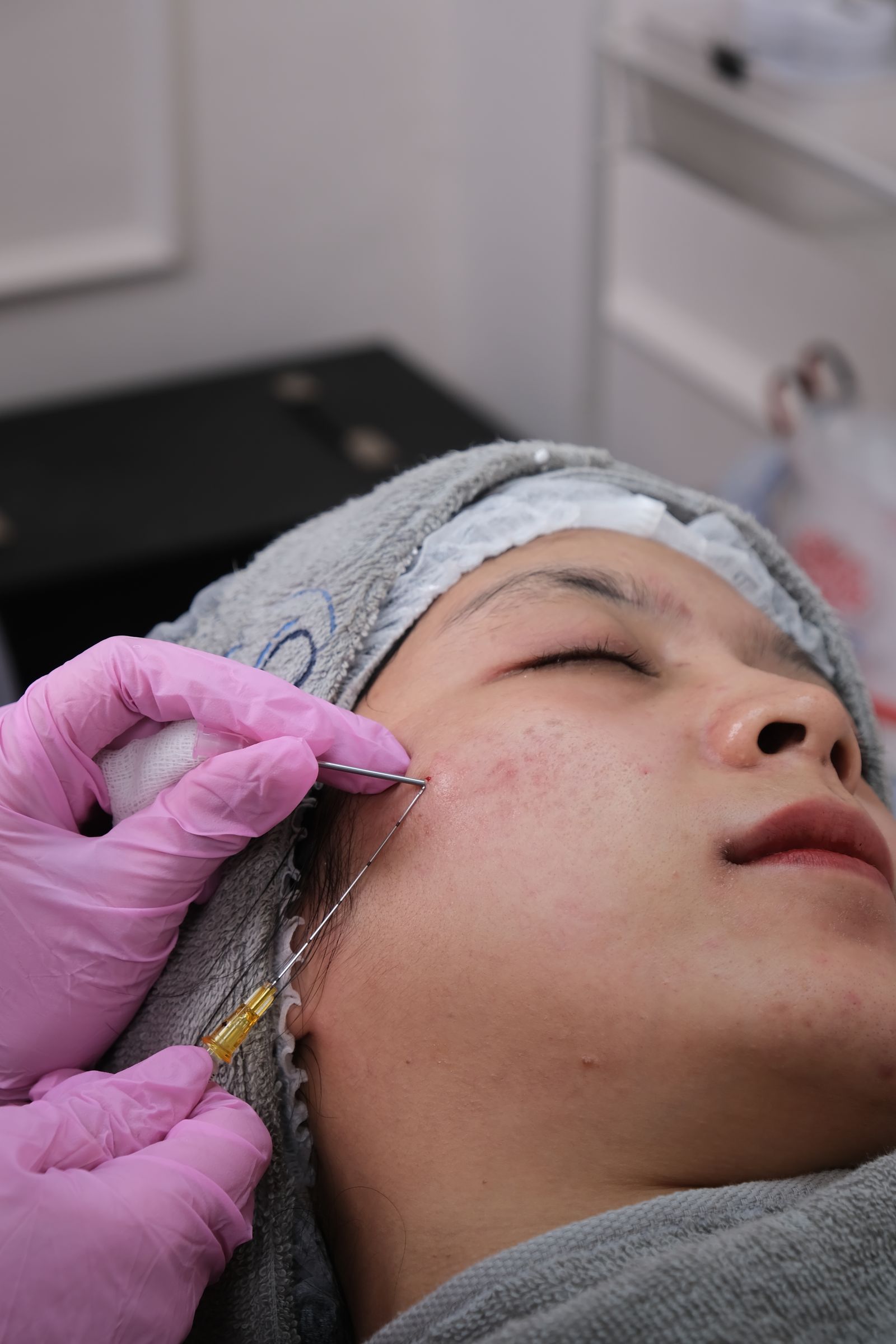
A clinic facial-procedure photograph. It illustrates the setting without verifying the exact technique, device or thread material.
- Often discussed for
- Selected early facial laxity, jowls and contour concerns
- Recovery guide
- Bruising or swelling for several days; settling can take weeks
Commonly known as
Names you may see for this category or its subtypes. Some describe a technique or a marketing concept rather than the same treatment.
- Thread lift / suture lift
- Names for a procedure using implanted sutures to support or reposition tissue. They do not describe one universal device or outcome.
- Absorbable suspension threads
- Threads designed to break down in the body. Absorption time, loss of strength and visible result duration are different measurements.
- PDO, PLLA and PCL threads
- Material names: polydioxanone, poly-L-lactic acid and polycaprolactone. The material alone does not identify thread design or authorization for a lifting use.
- Barbed / cog threads
- Projections engage tissue for mechanical suspension. Shape, anchoring and the exact product influence the procedure.
- Cone suspension sutures
- Cone elements engage tissue. A device may use different polymers in its filament and cones.
- Smooth / mono threads
- Unbarbed threads are often discussed for skin-quality goals. They should not be assumed to give the same mechanical lift as suspension devices.
- Lunchtime lift / non-surgical facelift
- Marketing descriptions. They do not establish zero recovery or a result equivalent to a surgical facelift.
What it can change
Lifting threads can engage tissue through barbs or cones. The visible change is generally limited and temporary. Threads do not remove excess skin or reproduce the deeper repositioning of a surgical facelift. Discuss whether your main concern is laxity, volume loss or texture and which alternatives address it.
Recovery and follow-up
Early bruising, swelling, discomfort or puckering can affect appearance. A same-day photograph is not the settled result. Ask for individualized activity restrictions, written aftercare and follow-up. A marketing name such as lunchtime lift does not establish that you can immediately return to every activity.
Risks and a management plan
Persistent pain, infection, thread extrusion, visible or palpable threads, contour irregularity and an unsatisfactory or asymmetric result are possible. Nerve injury has been reported. Some problems need treatment or removal. Ask who will manage complications and how an unwanted result would be assessed; waiting for absorption is not a complete plan.
“What can this exact thread device realistically change for me and how would a complication or a result I dislike be managed?”
Patient experiences76%“Worth It”Read patient summaries and sources
Selected accounts describe subtle contour improvement and satisfaction alongside short-lived change, limited lift, pain, puckering or visible threads.
RealSelf groups different products, techniques and providers under this heading. The score cannot distinguish individual approaches. Self-selected reviews reflect perceived value. They do not measure clinical success or your chance of a complication.
How to read these reviewsRead the original sources
Professional & regulatory sources
ASPS: Thread lift overview ASPS: Thread lift risks and safety ASPS: Thread lift recoveryGeneral education. Your clinician can assess your individual suitability. Rules depend on the treatment country; FDA references concern the United States. External sources may be in another language.